We use cookies to make your experience better. To comply with the new e-Privacy directive, we need to ask for your consent to set the cookies. Learn more.

 Giant Flag
 Flex Banner™
 Flex Blade®
 Bullet Flag
 Evo Banner™
 Car Flag
 Contour Flag™
 National Flag
 Personalized Flag
 Aire Flag Pro
 Backpacks
 Twizla™ Rotating Display
 Preprinted flag
 Accessories
 Canopy Tents
 Inflatable Dome Tent
 Inflatable Igloo Tent
 Changing Room Tent
 Inflatable Sider Tent
 Monaco™ Tent
 Teepee Tent
 Inflatable Shelter Tent
 Action Tent
 Tent Accessories
 Giant Inflatables
 Inflatable Tube Man
 Inflatable Blimp
 Blow Up Costume
 Inflatable Tents
 Inflatable Furniture
 Inflatable Archway
 Pumps & Accessories
 A-frame
 Retractable Banner
 X-Banner Stand
 Boulevard Street Banner
 Step and Repeat Backdrop
 Vinyl Banner
 Hanging Banner
 Floor Carpets & Stickers
 Custom Stickers
 Table Covers
 Counters
 Personalized Tables/Counters
 Custom Printed Table Covers/Throws
 Custom Printed Charging Stations
 Large Umbrellas
 Trade Show Displays
 Furniture
 Games
Games Promotional Products
 Kits/Bundled Products
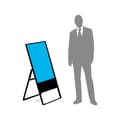 Retail Degital Compact A-Frame
 Hyper Lumin Touch Screen Kiosk
 Retail Digital Touch Screen Kiosk
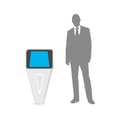 32 inch Indoor Floor Standing Kiosk
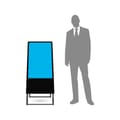 43 inch Folding A-Frame Digital Signage
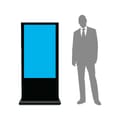 65 inch Outdoor Digital Kiosks
 Custom Printed Furniture
 Customized Inflatable Furniture
 Custom Branded Furnishings
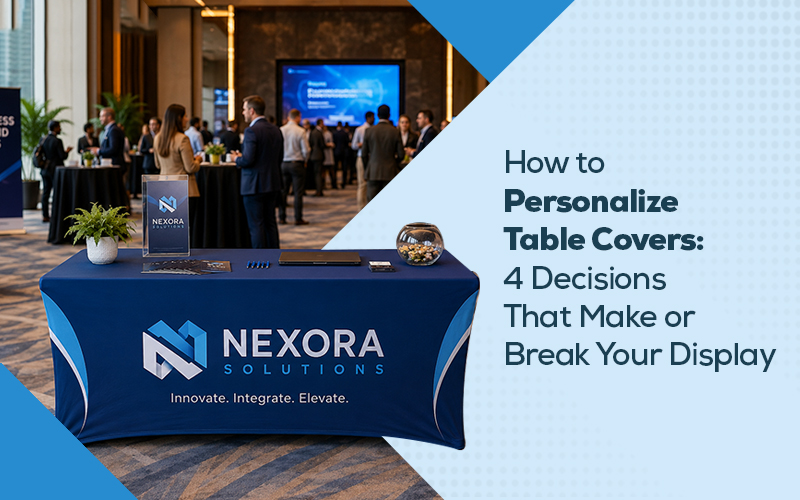
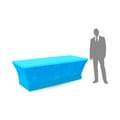
Personalizing a table cover comes down to four decisions: the size and shape of the table, the style of fit, the printing approach, and the material.
Get those four details right, and a plain folding table becomes a professional branded surface that looks intentional in person, in photographs, and across a busy trade-show floor.
A personalized table cover can be used to anchor a 10x10 exhibition booth, create a polished registration desk, display products at a market, support a conference check-in area, or help a business stand out at a community event.
Unlike temporary banners or loose printed signs, a branded tablecloth turns the table itself into part of the display. It creates a clean visual base for brochures, samples, product demonstrations, promotional items, and customer conversations.
The process is relatively simple, but the finished result depends on making the right choices before production begins.
Step 1: Match the Cover to Your Table Size and Shape
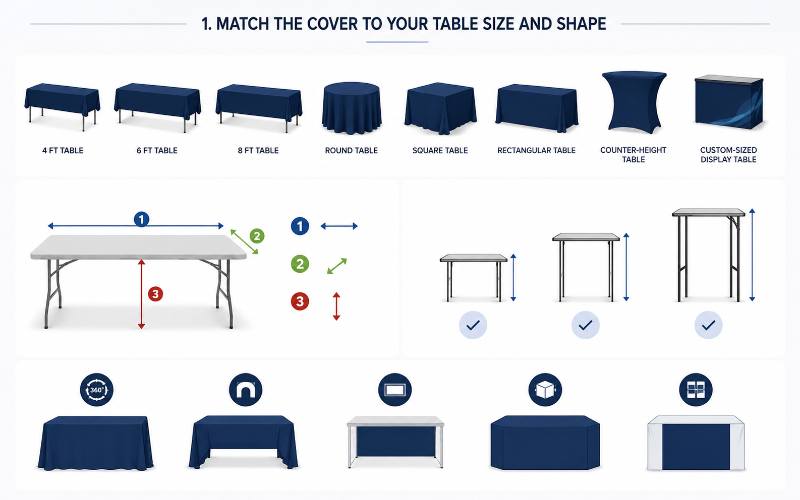
The first step is to identify the exact size and shape of the table.
Table covers are commonly produced for:
- 4 ft tables
- 6 ft tables
- 8 ft tables
- Round tables
- Square tables
- Rectangular tables
- Counter-height tables
- Custom-sized display tables
Standard folding tables are usually rectangular, but two tables with the same length may have different widths or heights. Measuring the table before ordering prevents the cover from hanging unevenly, exposing the table legs, or pooling excessively on the floor.
Measure three dimensions:
1. Length: From one end of the tabletop to the other.
2. Width: From the front edge to the back edge.
3. Height: From the floor to the top of the table.
These measurements determine how much fabric is needed and whether the cover will reach the floor on all sides.
Why Table Height Matters
Many standard folding tables are around the same height, but counters, demonstration tables, bar-height tables, and custom event furniture may be taller or shorter.
A cover designed for a standard table may not fit a raised counter correctly. It could leave the lower portion exposed or create uneven tension across the printed area.
If the table is non-standard, provide the exact dimensions rather than choosing the closest common size.
Decide How Many Sides Need Coverage
The placement of the table also affects the cover size.
A table positioned against a wall may only need full coverage across the front and sides. A table placed in the centre of an exhibition booth may need to look finished from every direction.
Common coverage options include:
- Four-sided coverage
- Three-sided coverage with an open back
- Front-only branding
- Full-wrap branding
- Custom panel placement
An open-back cover can make it easier for staff to sit behind the table or store boxes underneath it. A full four-sided cover creates a more polished appearance when visitors can walk around the display.
Step 2: Choose a Style of Fit
The fit determines the overall appearance of the branded table cover.
Some styles are relaxed and traditional, while others are tailored, modern, or designed for fast setup. The right choice depends on the event environment, the type of table, and how frequently the display will be transported.
There are four common table-cover styles.
Standard Table Throws
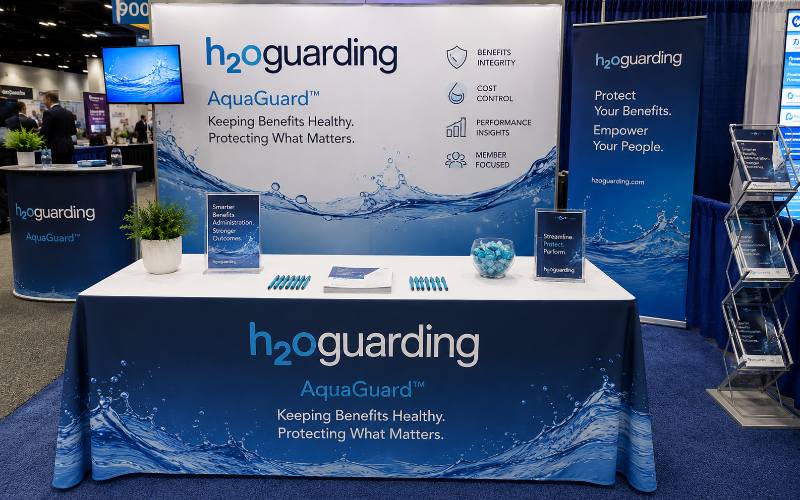
A standard table throw drapes naturally over the tabletop and hangs down the sides.
This is one of the most versatile options because it can be placed over the table quickly and folded flat after use.
Standard throws work well for:
- Conferences
- Registration desks
- Trade shows
- Community events
- Product demonstrations
- School and university events
- Retail promotions
- Hotel and hospitality displays
They create a classic look and can accommodate minor differences in table size more easily than tightly fitted covers.
A full throw usually covers all four sides. A three-sided version leaves the back open for seating, storage, or access to equipment.
Convertible Table Throws
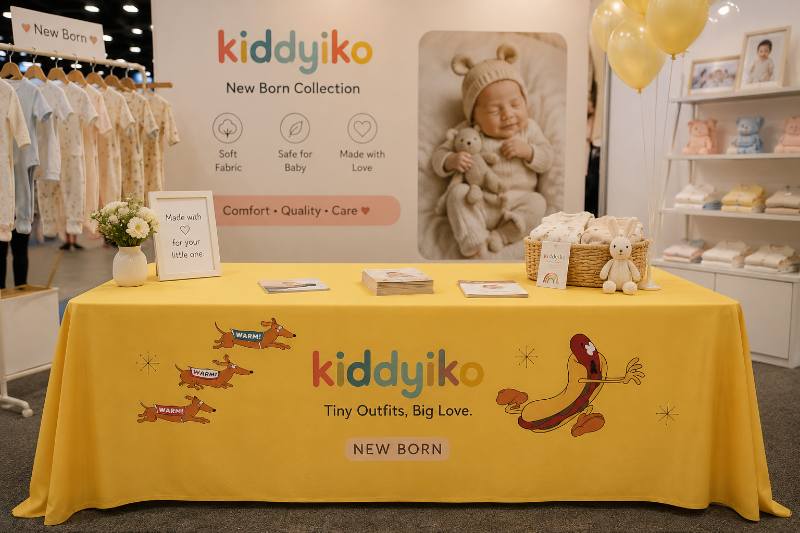
Convertible throws are designed to work across more than one table size.
For example, a convertible cover may adjust between an 8 ft table and a 6 ft table. This is useful for businesses that attend different events where table dimensions may vary.
Instead of ordering separate covers for every setup, the same branded cover can be adjusted to suit multiple booth configurations.
Convertible tablecloths may be especially useful for:
- Event agencies
- Touring sales teams
- Franchise businesses
- Universities
- Nonprofit organisations
- Exhibitors attending multiple venues
- Companies with changing booth sizes
The flexibility can reduce the amount of display material that needs to be stored and transported.
Fitted Tablecloths
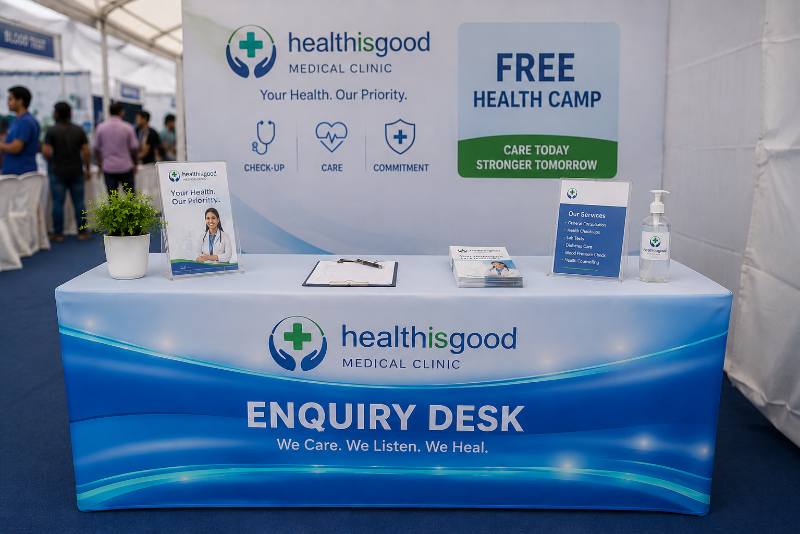
A fitted tablecloth is tailored to the dimensions of the table.
The corners are shaped to follow the table structure, creating a clean and structured appearance. Because the fabric is not intended to hang loosely, fitted covers tend to look more precise than traditional throws.
They are well suited to:
- Professional exhibitions
- Corporate events
- Showrooms
- Product launch displays
- Retail counters
- Media events
- Branded hospitality areas
A fitted tablecloth can also help reduce excess fabric around the base of the table, which may be useful in busy booths where staff and visitors are moving around frequently.
The exact measurements are particularly important for fitted covers because the design must align closely with the table dimensions.
Stretch or Contour Table Covers

Stretch table covers use elastic fabric that pulls tightly around the table.
The lower corners are usually secured around the table legs, creating a modern, sculpted shape. These covers are quick to install and stay relatively taut throughout the event.
Stretch covers work well for:
- High-traffic trade-show booths
- Technology events
- Sporting events
- Nightlife and entertainment activations
- Product sampling stations
- Pop-up retail
- Brand launches
- Outdoor promotional events
Their fitted appearance helps minimise loose fabric and gives the table a contemporary silhouette.
However, stretch covers need to match the intended table size closely. Using the wrong dimensions can cause excessive tension, poor alignment, or distortion of the printed logo.
Step 3: Decide How You Want the Logo Printed
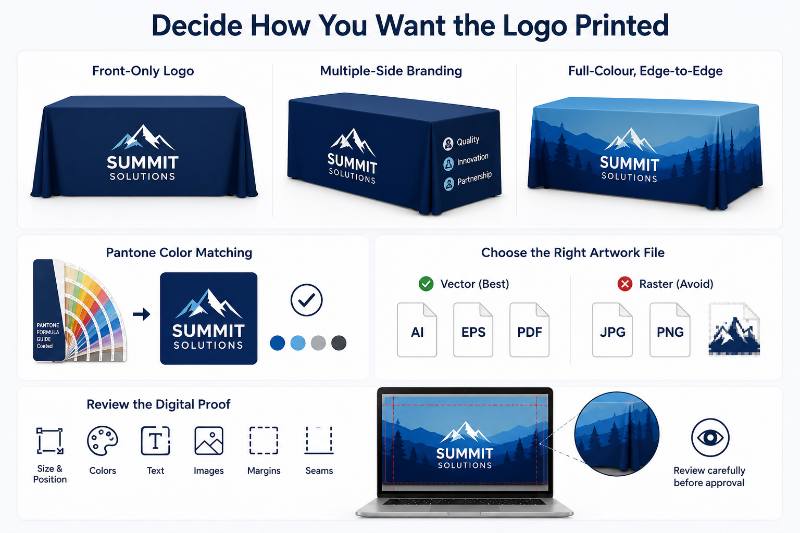
Once the table size and fit have been selected, the next step is to plan the artwork.
Above All Advertising prints personalized table covers using high-resolution dye-sublimation printing with Pantone color matching. This allows logos, photographs, gradients, patterns, and brand colours to be reproduced directly onto the fabric.
The right print layout depends on how the table will be viewed and how much visual information needs to be communicated.
Front-Only Logo Placement
Front-only printing places the primary logo or message on the side of the table facing visitors.
This is a simple option for tables that will remain against a wall, at the back of a booth, or in a fixed registration area.
It works well when the objective is to display:
- A company logo
- Event title
- Sponsor name
- Department name
- Website address
- Campaign message
The design should be positioned high enough to remain visible when people are standing in front of the table.
Multiple-Side Branding
Logos or graphics can be printed on the front, sides, or all visible panels.
This improves visibility when the table sits in an open booth, central display area, shopping centre, or event space where visitors approach from different directions.
Multiple-side branding can include:
- Main logo on the front
- Website or social handle on the sides
- Product categories around the table
- Sponsor logos on separate panels
- Repeating brand patterns
- Directional messaging
This approach turns the table cover into a 360-degree promotional display.
Full-Colour, Edge-to-Edge Printing
Full-colour printing allows the entire surface of the table cover to become part of the artwork.
Instead of placing one logo on a solid background, businesses can use:
- Brand patterns
- Full photographic graphics
- Product imagery
- Colour gradients
- Campaign artwork
- Illustrated designs
- Step-and-repeat logos
- Seasonal visuals
- Event-specific messaging
Edge-to-edge printing creates a more immersive branded look and can help a display stand out in a visually crowded environment.
Pantone Color Matching
Colour consistency is important when a business uses the same brand identity across signage, packaging, uniforms, brochures, and digital media.
Pantone matching helps reproduce the intended brand colours more accurately than relying on a visual approximation.
The appearance of a colour can still vary depending on the fabric, lighting, screen calibration, and print process, but providing official brand colour references gives the production team a much clearer target.
Businesses should submit:
- Pantone references
- CMYK values
- Vector logos
- Brand guidelines
- Approved artwork files
- Notes about critical colour requirements
Choosing the Right Artwork File
A high-quality print begins with high-quality artwork.
Vector files are preferred for logos because they can be enlarged without losing clarity. Common vector formats include AI, EPS, and certain PDF files.
High-resolution raster images may also be used, but they should be supplied at the recommended dimensions and resolution.
Avoid using:
- Screenshots of logos
- Images downloaded from social media
- Small JPEG files
- Blurry website graphics
- Logos copied from documents
- Artwork with missing fonts
- Unapproved colour versions
Low-resolution files can produce soft edges, pixelation, or poor print quality when enlarged across a table cover.
Review the Digital Proof Carefully
Before production, a digital proof shows how the artwork is expected to appear on the finished product.
Check:
- Logo size
- Logo position
- Text spelling
- Brand colours
- Image orientation
- Panel placement
- Safe margins
- Overall balance
- Whether important graphics fall near seams or edges
The proof should be reviewed on a larger screen whenever possible. Small details that look acceptable on a phone may become much more visible when printed across several feet of fabric.
Step 4: Pick a Material Built for Repeat Use
The material affects durability, appearance, portability, washability, and print quality.
For table covers that will be used repeatedly, look for durable polyester fabric with reinforced hems and high-quality printing.
Professional-grade branded tablecloths are often made from polyester because it offers a useful combination of strength, print performance, and manageable weight.
Why Polyester Works for Event Table Covers
Polyester is commonly used because it can:
- Hold printed colours well
- Fold for transport
- Resist everyday event wear
- Be cleaned and reused
- Work across indoor and outdoor settings
- Maintain a professional appearance
- Support full-colour dye-sublimation printing
A heavier material may create a more structured drape, while stretch polyester is used for fitted contour covers.
Understanding 600 Denier Polyester
Denier refers to the thickness and density of the fibres used in the material.
A 600 denier polyester fabric is a durable option commonly associated with products that need to withstand repeated handling. It offers a more substantial feel than lightweight decorative fabrics.
For branded table covers, the material can be suitable for:
- Trade shows
- Outdoor festivals
- Corporate events
- Retail promotions
- Conferences
- Product demonstrations
- Repeated setup and storage
The exact material should still be confirmed for the specific table-cover style, since standard throws, fitted covers, and stretch covers may use different fabric constructions.
Reinforced Hems
The edges of the cover receive significant wear during setup, folding, transportation, and cleaning.
Reinforced hems help protect the fabric and create a cleaner finished appearance. They can also reduce fraying around the lower edge.
Inspect the seams and corners periodically, especially when the cover is used frequently or transported between events.
UV- and Water-Resistant Printing
UV-resistant printing helps reduce fading caused by exposure to sunlight. Water resistance offers additional protection from light moisture and spills.
These features are useful for table covers used at outdoor events, but they do not make the fabric fully weatherproof.
Outdoor table covers should still be:
- Removed during severe weather
- Stored dry
- Protected from prolonged rain
- Kept away from standing water
- Secured in windy conditions
- Cleaned after exposure to dirt or moisture
How to Design a Branded Tablecloth That Is Easy to Read
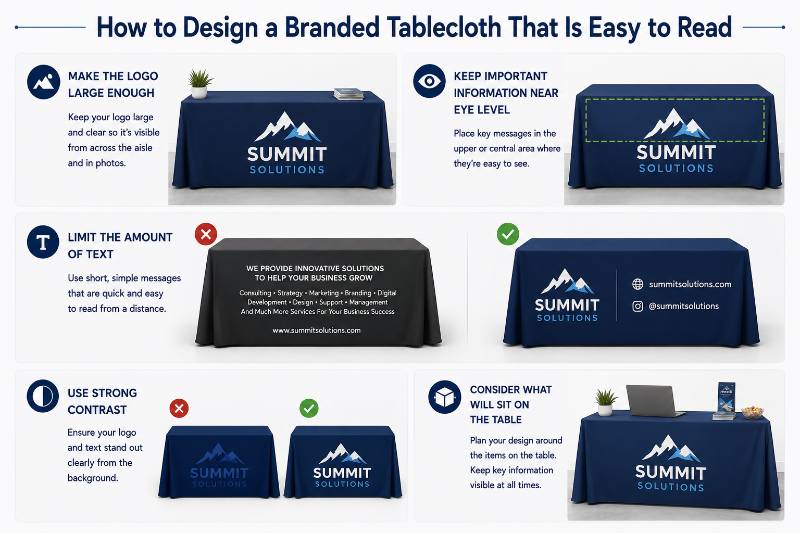
A table cover has a large printable area, but more content does not always create a better design.
The most effective layouts are usually clear, bold, and easy to recognise from several feet away.
Make the Logo Large Enough
A small logo may disappear once products, brochures, chairs, or visitors are positioned around the table.
The primary logo should be large enough to remain visible in event photographs and from across the aisle.
Keep Important Information Near Eye Level
The lower section of a table cover may be blocked by bags, boxes, people, or booth furniture.
Place the most important message in the upper or central part of the visible front panel.
Limit the Amount of Text
Long paragraphs are difficult to read on a tablecloth.
Focus on short information such as:
- Company name
- Website
- Tagline
- Social handle
- Event message
- Product category
- Call to action
Detailed product information is better placed on brochures, banners, or digital screens.
Use Strong Contrast
The logo and text should stand out clearly from the background.
Dark text on a dark background or pale text over a busy photograph may become difficult to read under exhibition lighting.
Consider What Will Sit on the Table
Products, display stands, laptops, bowls, brochures, and samples may cover parts of the design.
Plan the artwork around the objects that will be placed on the table. The tabletop print should not contain essential information if it will be hidden during the event.
Where Personalized Table Covers Are Used
Branded table covers are used across a wide range of business and event environments.
Common applications include:
- Trade shows
- Conferences
- Registration desks
- Job fairs
- School events
- University recruitment events
- Retail pop-ups
- Outdoor festivals
- Farmers markets
- Product launches
- Hotel events
- Sporting events
- Charity fundraisers
- Community programmes
- Food sampling stations
- Media check-in desks
- Awards ceremonies
- Franchise exhibitions
The same cover may be reused across different events as long as the artwork remains relevant and the table size stays consistent.
Care Tips to Keep a Personalized Table Cover Looking New
A personalized table cover can remain in use across many events when it is cleaned, transported, and stored properly.
Always follow the specific care instructions supplied with the product. General care practices include the following.
Machine Wash on a Gentle Cycle
When machine washing is permitted, use cold water and a gentle cycle.
Cold water helps reduce unnecessary stress on the fabric and printed colours.
Wash the cover separately or with similar lightweight materials. Avoid adding items with hooks, exposed zippers, or sharp fasteners that could catch the fabric.
Use Mild Detergent
Choose a mild detergent and avoid harsh bleach or aggressive stain removers unless they are specifically approved for the fabric.
Strong chemicals may affect the printed surface, fabric texture, or colour consistency.
Treat stains as soon as possible rather than allowing them to set between events.
Air Dry or Hang Dry
Air drying is generally safer than applying high heat.
Hang the cover evenly or lay it flat in a clean area. Make sure it is completely dry before folding and storing it.
Packing a damp tablecloth can cause odour, mildew, or staining.
Avoid Direct Heat on Printed Areas
Do not iron directly over printed graphics.
High heat may damage the ink, create shine marks, or affect the fabric. If wrinkle removal is required, follow the manufacturer’s instructions and use the lowest appropriate heat setting.
A fabric steamer may be suitable for some materials, but it should be tested carefully and kept at a safe distance.
Store It Flat or Loosely Folded
Avoid compressing the cover tightly for long periods.
Store it flat, loosely folded, or gently rolled in a clean, dry location. Keep it away from sharp hardware, adhesives, dirty stakes, and heavy display components.
Using a separate storage bag can help protect the cover during transport.
Clean the Cover Before Storage
Dust, food residue, spills, and outdoor dirt should be removed before the cover is packed away.
A clean cover is less likely to develop permanent marks and will be ready for the next event.
Common Mistakes to Avoid When Ordering Branded Tablecloths
Many table-cover problems can be prevented during the planning stage.
Ordering Without Measuring the Table
Do not rely only on the description “standard folding table.”
Measure the actual table or confirm the dimensions supplied by the event organiser.
Using a Low-Resolution Logo
A logo that looks sharp on a laptop screen may not remain clear when enlarged across a 6 ft or 8 ft table cover.
Submit vector artwork whenever possible.
Placing Text Too Close to the Bottom
Text near the lower edge may be difficult to see and may appear uneven if the floor is not level.
Keep key information within the main visible area.
Choosing the Wrong Fit for the Event
A loose throw may be ideal for a traditional conference, while a stretch cover may be better for a modern promotional activation.
Choose the style based on the intended environment rather than appearance alone.
Ignoring the Back of the Table
For a centrally positioned display, the back and side panels may be visible to visitors.
Plan for multi-sided branding when the table will not be placed against a wall.
Skipping the Proofing Stage
Never approve a design without checking the spelling, dimensions, orientation, and artwork placement.
The proof is the final opportunity to identify problems before printing begins.
Are Personalized Table Covers Worth It?
A personalized table cover is one of the simplest ways to make a temporary table look like part of a complete branded display.
It adds visual consistency, hides table legs and stored materials, improves event photographs, and creates a professional base for customer interactions.
Unlike disposable signs or event-specific printouts, a well-designed branded tablecloth can be reused across conferences, exhibitions, retail promotions, community events, and corporate functions.
For businesses that attend events regularly, the cover becomes a repeat-use display asset rather than a one-time decoration.
The most effective result comes from matching the table dimensions, selecting the right fit, supplying high-quality artwork, and choosing a material that can handle repeated use.
FAQ
Q: How can I personalize table covers for events or businesses?
A: Choose your table size and shape, pick a fit style (throw, fitted, or stretch), upload your logo for full-color dye-sublimation printing with Pantone matching, and select a durable, washable fabric like 600 denier polyester - Above All Advertising handles all four steps with a digital proof before production.
Q: What are branded tablecloths for events made of?
A: Most professional-grade branded tablecloths use durable polyester (commonly 600 denier) with UV- and water-resistant printing so they can be reused indoors and outdoors across many events.